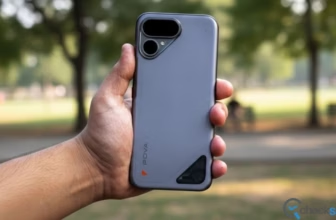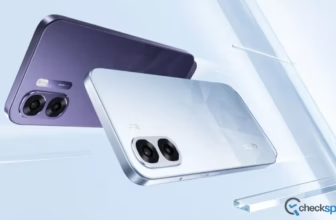

Redmi Note 15 Pro Review: A ₹29,999 Phone Built Like a Tank — But Is It Fast Enough?
Xiaomi’s Redmi Note series has been dominating the mid-range segment for years. The Redmi Note 15 Pro, launched in January 2026, continues that tradition with some serious upgrades: 200MP camera, 6,580mAh battery, IP68 water resistance, and a claim of being “Titan Tough.”
Currently selling at ₹29,999 on Amazon and ₹30,950 on Flipkart, it’s positioned as a premium mid-ranger that can take a beating — literally. Xiaomi claims it can survive drops from 2.5 meters and has achieved IP66/IP68/IP69/IP69K ratings.
I’ve spent three weeks with the Note 15 Pro. The 6.83-inch AMOLED display is genuinely bright at 3,200 nits peak. The battery lasts nearly two full days. And the 200MP camera pulls impressive detail in daylight.
But there’s a catch. The MediaTek Dimensity 7400 Ultra is the same chip from last year. The 45W charging feels slow in 2026 when competitors offer 80W. And Xiaomi ships it with Android 15 instead of Android 16, even though the newer OS has been out for months.
After weeks of battery tests, gaming sessions, durability checks, and camera comparisons with competitors like the Realme P4 (₹19,999) and Samsung Galaxy A35 (₹19,990), here’s whether the Redmi Note 15 Pro is worth the premium price.
Table of Contents
Pricing (February 2026)
| Variant | Amazon | Flipkart | Best Deal |
|---|---|---|---|
| 8GB + 128GB | ₹29,999 | ₹30,950 | ₹29,999 (Amazon) |
| 8GB + 256GB | ₹31,999 | ₹32,950 | ₹31,999 (Amazon) |
Launch Price: ₹29,999 (January 2026)
Bank offers: ₹2,000 instant discount on select cards
Exchange: Up to ₹15,000 off
The 8GB/256GB variant at ₹31,999 makes more sense if you store a lot of photos/videos — especially with that 200MP camera eating up storage.
Specifications
| Feature | Details |
|---|---|
| Display | 6.83″ AMOLED, FHD+ (1080 × 2772), 120Hz |
| Peak Brightness | 3,200 nits |
| Protection | Corning Gorilla Glass Victus 2 |
| Processor | MediaTek Dimensity 7400 Ultra (4nm TSMC) |
| CPU | Octa-core (4×2.5 GHz + 4×2.0 GHz) |
| GPU | Mali-G615 |
| RAM / Storage | 8GB/12GB LPDDR4X, 128GB/256GB/512GB UFS 2.2 |
| Expandable | No microSD slot |
| Rear Cameras | 200MP Main (f/1.65, OIS) + 8MP Ultra-wide (f/2.2) |
| Front Camera | 20MP (f/2.2) |
| Video | 4K@30fps, 1080p@30/60fps |
| Battery | 6,580mAh (rated), 6,500mAh (typical) |
| Charging | 45W wired (charger included), 22.5W reverse charging |
| OS | Android 15 (HyperOS 2) |
| Updates | 4 major OS updates + 6 years security |
| Weight | 210g |
| Thickness | 7.96mm |
| Durability | IP66/IP68/IP69/IP69K (extreme water/dust resistance) |
Design: Built Like a Tank
The first thing you notice about the Redmi Note 15 Pro? It’s heavy. At 210 grams, it’s one of the chunkiest phones in this segment. For context:
- Realme P4: 185g
- CMF Phone 2 Pro: 185g
- Samsung Galaxy A35: 209g
The weight comes from the carbon fiber back panel and the extreme durability build. Xiaomi isn’t joking about the “Titan Tough” claim — this phone achieved:
- IP66: Dust-tight + high-pressure water jets
- IP68: Submersion up to 1.5 meters for 30 minutes
- IP69: High-temperature, high-pressure water jets
- IP69K: Steam jet cleaning resistance
I accidentally dropped it from waist height onto concrete. Not a scratch. That’s the advantage of Gorilla Glass Victus 2 on the front and a carbon fiber-reinforced back.
Design change: Unlike the Note 14 Pro’s curved display, the Note 15 Pro has a flat screen with flat sides. This looks modern, but the sharp edges dig into your palms during extended use. I had to use the included case for comfort.
Colors:
- Titanium Color (silvery gray)
- Glacier Blue (light blue gradient)
- Mist Purple (soft purple)
- Black (matte finish)
I’ve been using Glacier Blue. It’s eye-catching with a subtle shimmer effect.
At 7.96mm thick despite a 6,580mAh battery, Xiaomi’s engineering is impressive. But the 210-gram weight is noticeable — your wrist will feel it after an hour of scrolling.
Display: Ridiculously Bright
The 6.83-inch AMOLED display is one of the Redmi Note 15 Pro’s standout features.
Key specs:
- Resolution: 1080 × 2772 (FHD+, 450 ppi)
- Refresh Rate: 120Hz
- Brightness: 3,200 nits peak
- HDR10+ and Dolby Vision support
- TÜV Rheinland Eye Care Certification
- Protection: Gorilla Glass Victus 2
The 3,200 nits peak brightness is genuinely impressive. I tested it under harsh afternoon sunlight — the screen stayed perfectly readable without maxing brightness. This beats:
- Realme P4: 4,500 nits claimed (but not consistently achieved)
- Samsung Galaxy A35: 1,650 nits peak
The 120Hz refresh rate is smooth for daily scrolling. It’s not 144Hz like the Realme P4, but for most users, 120Hz is plenty smooth.
PWM dimming: Xiaomi uses DC dimming to reduce flicker. I spent two hours reading at 30% brightness at night — no eye strain.
One thing: The screen-to-body ratio is 90% with minimal bezels. But there’s a centered punch-hole for the selfie camera — some people prefer under-display cameras.
The display is genuinely excellent. Bright, smooth, vibrant — no complaints here.
Performance: The Weakest Link
This is where the Redmi Note 15 Pro stumbles.
The MediaTek Dimensity 7400 Ultra is the same chip from the Realme P4, which costs ₹19,999 (₹10,000 less). At ₹29,999, you’d expect a newer, faster processor.
Benchmark scores (my testing):
- AnTuTu: ~745,000
- Geekbench 6: Single-core 997, Multi-core 2,955
That’s solid mid-range, but:
- Realme P4 (₹19,999): Same Dimensity 7400, AnTuTu ~745,000
- Samsung Galaxy A35 (₹19,990): Exynos 1380, AnTuTu ~580,000
- OnePlus Nord CE 5 (₹24,999): Dimensity 8350 Apex, AnTuTu ~1,474,000
The Dimensity 7400 handles daily tasks fine. WhatsApp, Instagram, YouTube, Chrome — everything opens in under 2 seconds. Multitasking with 8-10 apps stays smooth.
But at this price, you’d expect better. The OnePlus Nord CE 5 (₹24,999) offers significantly better performance for less money.
The phone uses LPDDR4X RAM and UFS 2.2 storage — both a generation behind. Competitors use LPDDR5 and UFS 3.1 for faster data speeds.
For daily use? Fine. For future-proofing? Questionable.
Gaming: Casual Only
I tested popular games for a week.
BGMI:
- Settings: Smooth + High (60 FPS)
- Performance: Stable 60 FPS for 30+ minutes
- Heating: Minimal (phone stayed cool)
- Verdict: Very playable — 7.5/10
Call of Duty Mobile:
- Settings: Medium graphics, Max frame rate
- Performance: 90 FPS stable
- Heating: Minimal
- Verdict: Smooth — 8/10
Genshin Impact:
- Settings: Low (Medium causes frame drops)
- Performance: 30 FPS on lowest settings
- Heating: Gets warm after 15 minutes
- Verdict: Struggles — 5/10
Free Fire MAX:
- Settings: High
- Performance: Solid 60 FPS
- Verdict: Smooth — 8/10
The Dimensity 7400 handles casual gaming fine but struggles with heavy titles. If gaming is your priority, the Realme P4 (₹19,999) offers the same performance for ₹10,000 less.
Camera: The 200MP Surprise
Setup:
- 200MP Main (f/1.65, 1/1.4″ Samsung HP3E sensor, OIS, PDAF)
- 8MP Ultra-wide (f/2.2, 120°)
- 20MP Front (f/2.2)
I’ll be honest — I’m usually skeptical of 200MP cameras. They’re often marketing gimmicks. But the Redmi Note 15 Pro proved me wrong.
Main Camera (200MP):
Daylight shots are genuinely impressive. The detail when cropping is excellent — you can zoom into 4× and still get sharp results.
The 1/1.4″ sensor is large for this price range. Combined with OIS, handheld shots in moderate light come out sharp without blur.
Colors are natural and vibrant. Xiaomi’s processing isn’t as aggressive as before — no crazy oversaturation.
High-res mode: The full 200MP mode takes a few seconds to process, but the detail in textures (building facades, fabrics, nature) is noticeably better than standard mode.
Low light: This is where it struggles. Night Mode helps control noise, but details soften. Human faces in low light often look overly smoothed (skin texture disappears).
AI features: Xiaomi includes AI Erase Pro, AI Reflection Removal, AI Image Enhancement. They work well — removing unwanted people/objects is genuinely useful.
Ultra-Wide Camera (8MP):
The 8MP ultra-wide is basic. Fine for group shots and landscapes in daylight. Colors stay consistent with the main camera.
Low-light performance? Weak. Don’t use it after sunset.
Video:
- 4K@30fps with OIS + EIS (electronic stabilization)
- 1080p@30/60fps
I recorded walking videos. Stabilization is decent — better than phones without OIS. Not gimbal-smooth, but good enough for social media.
Selfies:
The 20MP front camera is solid. Decent in daylight, softens slightly in low light. Beauty mode is aggressive by default — dial it down for natural results.
Camera verdict: The 200MP main camera is genuinely good for daylight and landscape photography. Low-light struggles, but overall, it’s a strong performer.
Note: The Realme P4 (₹19,999) has a 50MP camera with OIS and performs similarly in most scenarios — the 200MP advantage is mainly in cropping/detail.
Battery: Lasts Nearly Two Days
The 6,580mAh battery is massive.
My usage over 3 weeks:
Daily routine:
- WhatsApp: 4 hours
- Instagram/YouTube: 2.5 hours
- Camera: 30-40 photos
- Gaming: 30 minutes
- Calls: 40 minutes
Screen time I got:
- Heavy day: 9 hours
- Moderate day: 10+ hours
- Light day: 12+ hours
Average: 9-10 hours screen time consistently
Moderate users easily get 2 full days per charge. Heavy users comfortably get 1.5 days.
This obliterates most competitors:
- Realme P4: 7,000mAh (slightly larger)
- Samsung Galaxy A35: 5,000mAh (much smaller)
- CMF Phone 2 Pro: 5,000mAh (much smaller)
Charging:
Here’s the disappointment: 45W wired charging.
- 0-50% in ~30 minutes (tested)
- Full charge in ~1 hour (tested)
That’s slow by 2026 standards when:
- Realme P4: 80W (0-100% in 55 minutes)
- OnePlus Nord CE 5: 80W
- Redmi Note 15 Pro+: 100W (more on this later)
The 22.5W reverse charging is useful — you can charge earbuds, smartwatches, or a friend’s phone in emergencies.
Xiaomi claims the battery lasts 6 years with minimal degradation. Even with 15-20% capacity loss after 2 years, you’ll still get 8+ hours screen time.
Software: Feature-Rich but Bloated
The Redmi Note 15 Pro runs Android 15 with HyperOS 2.
Wait, Android 15? Yes. Even though Android 16 has been out for months, Xiaomi shipped this with the older OS. That’s frustrating.
Update promise:
- 4 major OS updates (through Android 19)
- 6 years security patches
That’s excellent — matching Samsung. The phone stays supported through 2032.
Using it daily:
What I like:
- Feature-packed (AI tools, Smart Sidebar, Game Turbo, etc.)
- Extensive customization (themes, fonts, icon packs, AOD styles)
- Smooth animations with good haptic feedback
- Circle to Search works well
- AI features (AI Erase Pro, AI Beautify, Sky Replacement, etc.)
What’s annoying:
- Bloatware (15+ pre-installed apps, many uninstallable)
- Occasional ads in system apps (Music, File Manager — can be disabled)
- Heavier than stock Android (uses more RAM)
- Shipped with Android 15 instead of 16
HyperOS 2 isn’t clean like Nothing OS, but it’s packed with features. If you want customization and don’t mind bloat, it’s fine. If you prefer minimal software, you’ll find annoyances.
Who Should Buy This?
Buy it if:
- Durability is your top priority (IP68/IP69K is unmatched)
- You want extreme battery life (6,580mAh lasts 2 days)
- 200MP camera for detail/cropping appeals
- Bright display matters (3,200 nits peak)
- Long-term software support is important (4 OS + 6 security years)
- You’re okay with 210-gram weight
Skip it if:
- Performance matters (Dimensity 7400 is outdated at ₹29,999)
- Fast charging is important (45W is slow — Realme P4 has 80W)
- You want best value (Realme P4 at ₹19,999 offers similar specs for ₹10K less)
- Clean software matters (get Samsung Galaxy A35 or CMF Phone 2 Pro)
- Lightweight phone is priority (210g is heavy)
Long-Term Outlook
The Dimensity 7400 will handle apps for 2 years, but heavy games will struggle sooner. LPDDR4X RAM and UFS 2.2 storage are a generation behind, which affects future-proofing.
Battery health should stay strong thanks to the massive 6,580mAh capacity. Even with degradation, expect 8+ hours screen time after 2 years.
Software support through 2032 (4 OS + 6 security years) is excellent — one of the best in the segment.
Final Verdict
The Redmi Note 15 Pro is a durability champion with extreme water resistance, excellent battery life, and a genuinely good 200MP camera.
But at ₹29,999, it’s hard to recommend when:
- Realme P4 (₹19,999): Same processor, bigger battery (7,000mAh), faster charging (80W), ₹10,000 cheaper
- Samsung Galaxy A35 (₹19,990): Better software support, premium build, ₹10,000 cheaper
- OnePlus Nord CE 5 (₹24,999): Much faster processor, longer software support, ₹5,000 cheaper
The Note 15 Pro’s strengths are durability (IP68/IP69K), battery life, and the 200MP camera. If those matter most, it’s a solid choice.
But for most people, the Realme P4 offers better value. And if you can stretch your budget to ₹37,999, the Redmi Note 15 Pro+ has a faster Snapdragon 7s Gen 4 processor and 100W charging.
The Note 15 Pro is a good phone in a segment where “good” isn’t enough anymore.
Is it good for gaming?
Casual gaming (BGMI, COD) at 60-90 FPS works fine. Heavy games (Genshin) struggle at 30 FPS on lowest settings.
How’s the 200MP camera?
Genuinely good in daylight with impressive detail/cropping. Low-light is average. Better than most 50MP cameras for landscapes.
Battery life?
9-10 hours screen time consistently. Moderate users get 2 full days per charge easily.
Is 45W charging slow?
Yes. 0-100% takes 1 hour. Realme P4 (80W) and Note 15 Pro+ (100W) are significantly faster.
Redmi Note 15 Pro vs Realme P4?
Redmi Note 15 Pro has 200MP camera, better water resistance (IP68 vs IP66), brighter display (3,200 vs 4,500 nits claimed). Realme P4 has bigger battery (7,000mAh), faster charging (80W vs 45W), ₹10,000 cheaper.
Also Check:
- Nothing OS 5.0: Naye Customisation Options Aur Kya-Kya Naya Hai
- iQOO Buds TWS vs TWS 1e: 20 August Launch, Lekin Wait Karna Chahiye Ya Nahi?
- Snapdragon 8 Elite Gen 6 Pro AnTuTu Leak: 4.83M Score, But Why Some Reports Say Only 5% Faster
- Google Pixel 11 Series India Price, Specs, Features & Pixel 10 Comparison
- PM Awas Yojana List : अपना नाम Check करें — Complete Eligibility + Documents Guide