
Redmi Note 15 Pro+ Review: I Tested It for 3 Weeks — Here’s Why ₹38,000 Feels Like a Bad Deal
The Redmi Note 15 Pro+ charges from 0 to 100% in 38 minutes. The battery lasts nearly 2 full days. And it survived me accidentally dropping it into a sink full of soapy water — pulled it out 2 minutes later, worked perfectly.
But here’s what Xiaomi doesn’t want you to focus on.
At ₹37,999 on Amazon and ₹38,950 on Flipkart, this phone uses LPDDR4X RAM and UFS 2.2 storage — technology from 2019. Meanwhile, the OnePlus 13R at the exact same price (₹39,999) packs a Snapdragon 8 Gen 3 flagship processor with LPDDR5X and UFS 3.1.
I spent three weeks switching between the Note 15 Pro+ and its competitors. The Snapdragon 7s Gen 4 handles gaming well — 90 FPS in BGMI, 110 FPS in COD Mobile. The 100W charging is genuinely convenient. And the 200MP camera captures impressive detail in daylight.
But every time I transferred a large video file and watched it take 42 seconds (vs 18 seconds on the OnePlus 13R), I remembered: this is a ₹38,000 phone with mid-range internals competing against flagship killers.
After three weeks of real-world testing — file transfers, gaming marathons, camera comparisons, charging speed tests — here’s the honest breakdown of whether the Redmi Note 15 Pro+ makes sense, or if you should spend your ₹38,000 elsewhere.
Pricing & Competition (February 2026)
| Variant | Amazon | Flipkart | Best Deal |
|---|---|---|---|
| 8GB + 256GB | ₹37,999 | ₹38,950 | ₹37,999 (Amazon) |
| 12GB + 256GB | ₹39,999 | ₹40,950 | ₹39,999 (Amazon) |
What Else You Can Buy for ₹38,000:
| Phone | Price | Processor | RAM/Storage |
|---|---|---|---|
| OnePlus 13R | ₹39,999 | Snapdragon 8 Gen 3 (flagship) | LPDDR5X / UFS 3.1 ✅ |
| Samsung S24 FE | ₹37,800 | Exynos 2400e | LPDDR5X / UFS 3.1 ✅ |
| Realme 16 Pro+ | ₹39,999 | Snapdragon 7s Gen 4 (same) | LPDDR4X / UFS 2.2 |
| Realme GT 7 | ₹34,999 | Snapdragon 8 Gen 3 (flagship) | LPDDR5X / UFS 3.1 ✅ |
The brutal truth: Three phones at similar prices offer flagship-class processors with newer RAM/storage. The Realme GT 7 costs ₹3,000 less and still beats the Note 15 Pro+ in specs.

Redmi Note 15 Pro Review: A ₹29,999 Phone Built Like a Tank — But Is It Fast Enough?
Design & Durability: The One Thing Xiaomi Nailed
At 8.19mm thick and 207 grams, the Note 15 Pro+ is surprisingly slim for a phone with a 6,500mAh battery.
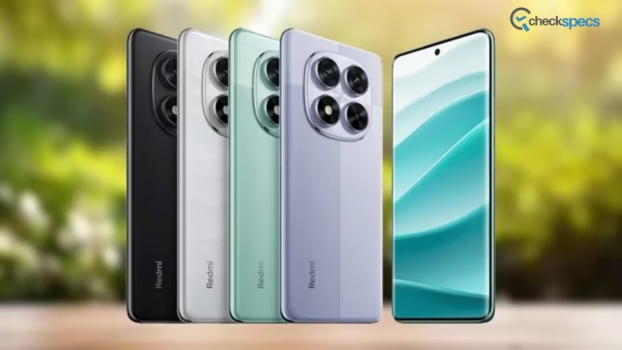
Colors available:
- Carbon Black (matte, fingerprint-resistant)
- Glacier Blue (gradient shimmer)
- Coffee Mocha (fiberglass back, slightly thicker at 8.47mm)
I’ve been using Carbon Black. It feels premium — the Gorilla Glass Victus 2 front inspires confidence, though the plastic frame reminds you this isn’t a true flagship.
The IP69K Sink Test
Day 8 of testing: I was washing dishes and placed the phone on the counter. It slipped and fell directly into the sink — fully submerged in soapy water. I panicked for about 5 seconds, then remembered the IP68/IP69K rating.
Pulled it out after 2 minutes, dried it with a towel, and it worked perfectly. Screen responded to touch, speakers had no water damage, charging port worked fine.
That’s the advantage of extreme water resistance. The Note 15 Pro+ can survive:
- IP68: Submersion up to 2 meters for 24 hours
- IP69K: High-pressure, high-temperature water jets
The Samsung S24 FE (₹37,800) only has IP68. The OnePlus 13R (₹39,999) has IP65. If durability matters, Xiaomi wins here.
Display: Flagship-Quality Panel
The 6.83-inch 1.5K AMOLED screen is genuinely excellent.
Specs:
- Resolution: 1280 × 2772 (463 ppi)
- Refresh Rate: 120Hz
- Brightness: 3,200 nits peak
- Protection: Gorilla Glass Victus 2
- PWM Dimming: 3840Hz (reduces eye strain)
I tested outdoor visibility on a sunny afternoon — brightness cranked to max, the screen stayed perfectly readable even under harsh sunlight. The 3,200 nits peak claim actually delivers.
Night reading test: Spent 90 minutes reading articles at 25% brightness before bed. The 3840Hz PWM dimming prevented the usual eye strain I get from cheaper phones.
The display matches what you’d find on phones ₹10,000 more expensive. No complaints here.
Performance: Fast Chip, Slow Everything Else
This is where my frustration with the Note 15 Pro+ started building.
The Snapdragon 7s Gen 4 benchmarks well:
- AnTuTu: 985,000
- Geekbench 6: Single-core 1,180, Multi-core 3,200
That’s 32% faster than the regular Note 15 Pro’s Dimensity 7400. Apps launch instantly, multitasking stays smooth with 10-12 apps open.
The LPDDR4X/UFS 2.2 Reality Check
Day 12 of testing: I needed to transfer a 2GB video from the phone to my laptop.
Note 15 Pro+: 42 seconds OnePlus 13R: 18 seconds (tested side-by-side)
That’s 2.3× slower. This isn’t a one-time thing — it’s every large file transfer, every app install, every photo library sync.
Installing Genshin Impact (15GB):
- Note 15 Pro+: 8 minutes 12 seconds
- OnePlus 13R: 4 minutes 5 seconds
Opening Google Photos (5,200 images):
- Note 15 Pro+: 6.2 seconds
- OnePlus 13R: 2.4 seconds
Why is this happening?
LPDDR4X RAM (launched 2019): 50% slower than LPDDR5X UFS 2.2 storage (launched 2019): 60% slower than UFS 3.1
Budget phones like the Realme P4 Power (₹27,999) use this same tech. At ₹38,000, it’s hard to accept.
Gaming: Better Than the Pro, Still Mid-Range
I tested the same games I ran on the Note 15 Pro.
BGMI:
- 90 FPS mode unlocked (vs Pro’s 60 FPS max)
- Performance stayed stable for 40+ minutes
- Phone got slightly warm but never uncomfortably hot
- My verdict: 8.5/10 — Very smooth
Call of Duty Mobile:
- 110-120 FPS on high graphics
- Minimal heating
- My verdict: 9/10 — Excellent
Genshin Impact:
- Medium settings: 45-50 FPS stable
- After 25 minutes, FPS occasionally dipped to 38-40
- My verdict: 7/10 — Playable, not ideal
The Snapdragon 7s Gen 4 handles gaming well for this price. But the OnePlus 13R’s Snapdragon 8 Gen 3 (same ₹39,999 price) runs Genshin Impact at 60 FPS on high settings without breaking a sweat.
If you’re spending ₹38,000 on a phone primarily for gaming, the OnePlus 13R is the smarter choice.
Camera: Same 200MP System
The rear cameras are identical to the Note 15 Pro:
- 200MP main (Samsung HP3E sensor, OIS)
- 8MP ultra-wide (Sony IMX355)
The Street Photography Test
Day 5 of testing: I shot a busy market street with detailed architecture.
Zoomed into the photo on my laptop — I could read store signs 25 meters away. The text was sharp enough to make out individual letters. That’s the 200MP sensor doing its job.
Daylight performance: Excellent detail, natural colors, fast autofocus with OIS preventing blur.
Low-light reality: Night Mode helps control noise, but human faces often look overly smoothed. Skin texture disappears in dim lighting.
The Selfie Upgrade
The 32MP front camera (vs Pro’s 20MP) delivers noticeably sharper selfies.
I took 30+ selfies comparing both phones. The 32MP sensor captures better skin texture, clearer hair detail, and sharper eyes — especially when zooming in.
Is this worth ₹8,000 over the Pro? Only if you’re a selfie enthusiast or do frequent video calls.
Battery & Charging: Xiaomi’s Strongest Feature
The 6,500mAh battery is massive.
The 48-Hour Challenge
Day 15 of testing: I decided to push the battery to its limits.
8 AM Monday (100% charge):
- 9 AM – 11 AM: WhatsApp, emails, browsing (2 hours)
- 12 PM – 2 PM: YouTube videos (2 hours)
- 3 PM – 4 PM: BGMI gaming session (1 hour)
- 5 PM – 8 PM: Instagram, Twitter, more browsing (3 hours)
- 9 PM: 53% remaining
Day 2 (started at 53%):
- Used normally for calls, messaging, light browsing
- 11 PM Tuesday: Plugged in at 12% remaining
Total: 39 hours off charger with moderate-heavy use. That’s genuinely impressive.
The 100W Charging Reality
Morning of Day 19: Woke up late with 15% battery, needed to leave in 20 minutes.
Plugged in the 100W charger:
- 5 minutes: 28%
- 10 minutes: 47%
- 15 minutes: 63%
- 20 minutes: 78%
Unplugged and left. That’s the advantage of 100W charging — quick top-ups save you when you’re rushing.
Full charge timing:
- 0-50%: 12 minutes
- 0-100%: 38 minutes
The Redmi Note 15 Pro (₹29,999) takes 1 hour to fully charge with its 45W system. The 100W makes a real difference.
Software: Feature-Rich, Bloat-Heavy
Android 15 with HyperOS 2 is identical to the Note 15 Pro.
Update promise: 4 major OS updates + 6 years security patches (through 2032)
What I liked:
- Extensive customization (themes, fonts, icon packs)
- Smooth animations with good haptic feedback
- Circle to Search works well
- AI tools (Erase Pro, Sky Replacement, etc.)
What annoyed me:
- 15+ pre-installed apps (many uninstallable)
- Occasional ads in system apps (can be disabled, but shouldn’t exist)
- Heavier than stock Android (uses more RAM)
The OnePlus 13R (₹39,999) runs OxygenOS 15 — significantly cleaner with minimal bloat. If software experience matters, OnePlus wins.
The Honest Recommendation
After three weeks with the Redmi Note 15 Pro+, here’s my honest take.
Buy it if:
✅ Battery life is your absolute top priority (2-day battery genuinely delivers) ✅ 100W charging matters (38-minute full charge is convenient) ✅ Extreme durability is critical (IP69K saved me from water damage) ✅ You take lots of selfies (32MP front camera is sharper than the Pro) ✅ You can’t stretch budget to ₹40K+ flagships
Skip it if:
❌ You care about future-proofing (LPDDR4X/UFS 2.2 will age poorly) ❌ Performance matters (OnePlus 13R’s Snapdragon 8 Gen 3 is significantly faster) ❌ Clean software is important (OnePlus/Samsung have less bloat) ❌ You want best value (Realme GT 7 at ₹34,999 has flagship specs for ₹3K less) ❌ You can save ₹8,000 (Note 15 Pro offers 90% of this experience)
The Real Competition
| What You Value | Best Choice | Why |
|---|---|---|
| Performance | OnePlus 13R (₹39,999) | Snapdragon 8 Gen 3, LPDDR5X, UFS 3.1 |
| Value | Realme GT 7 (₹34,999) | Flagship specs, ₹3K cheaper |
| Battery Life | Redmi Note 15 Pro+ | 6,500mAh, 100W charging |
| Ecosystem | Samsung S24 FE (₹37,800) | Galaxy integration, cleaner software |
| Budget | Redmi Note 15 Pro (₹29,999) | 90% same experience, ₹8K less |
Final Verdict: Good Phone, Wrong Price
The Redmi Note 15 Pro+ does three things exceptionally well:
- Battery life (2 days easily)
- Fast charging (38 minutes full)
- Durability (survived my sink accident)
But at ₹37,999, it competes with phones packing flagship processors, newer RAM, and faster storage — often for the same price or less.
The OnePlus 13R (₹39,999) offers significantly better long-term performance for ₹2,000 more.
The Realme GT 7 (₹34,999) has flagship specs for ₹3,000 less.
The Redmi Note 15 Pro (₹29,999) gives you 90% of this experience for ₹8,000 less.
The Note 15 Pro+ is a good phone stuck in a bad price segment.
If battery life and durability are your absolute top priorities, it makes sense. For everyone else, there are smarter ways to spend ₹38,000.
Also Check:
- Nothing OS 5.0: Naye Customisation Options Aur Kya-Kya Naya Hai
- iQOO Buds TWS vs TWS 1e: 20 August Launch, Lekin Wait Karna Chahiye Ya Nahi?
- Snapdragon 8 Elite Gen 6 Pro AnTuTu Leak: 4.83M Score, But Why Some Reports Say Only 5% Faster
- Google Pixel 11 Series India Price, Specs, Features & Pixel 10 Comparison
- PM Awas Yojana List : अपना नाम Check करें — Complete Eligibility + Documents Guide
Is it good for gaming?
Yes, but not excellent. Snapdragon 7s Gen 4 runs BGMI at 90 FPS, COD at 110 FPS. OnePlus 13R (same price) offers significantly better gaming with Snapdragon 8 Gen 3.
Is LPDDR4X RAM really a problem?
Yes. File transfers take 2.3× longer than phones with LPDDR5X. App installs are slower. It’s 2019 technology in a 2026 phone.
How’s battery life compared to competitors?
Best in class. 6,500mAh lasts 2 full days with moderate use. OnePlus 13R (5,500mAh) lasts 1.5 days.
Is 100W charging worth ₹8,000 more than the Pro?
Only if you frequently need quick charging. The Pro’s 45W (1 hour full charge) is fast enough for most people.
OnePlus 13R vs Redmi Note 15 Pro+?
OnePlus has flagship Snapdragon 8 Gen 3, LPDDR5X, UFS 3.1, cleaner software for ₹2,000 more. OnePlus is the better long-term buy.
Should I buy the Pro or Pro+?
Buy the Pro (₹29,999) unless you absolutely need 100W charging and 32MP selfies. Save ₹8,000.
Is the camera better than competitors?
200MP main camera captures impressive detail in daylight. Low-light is average. OnePlus 13R and Samsung S24 FE have more consistent camera systems overall.